
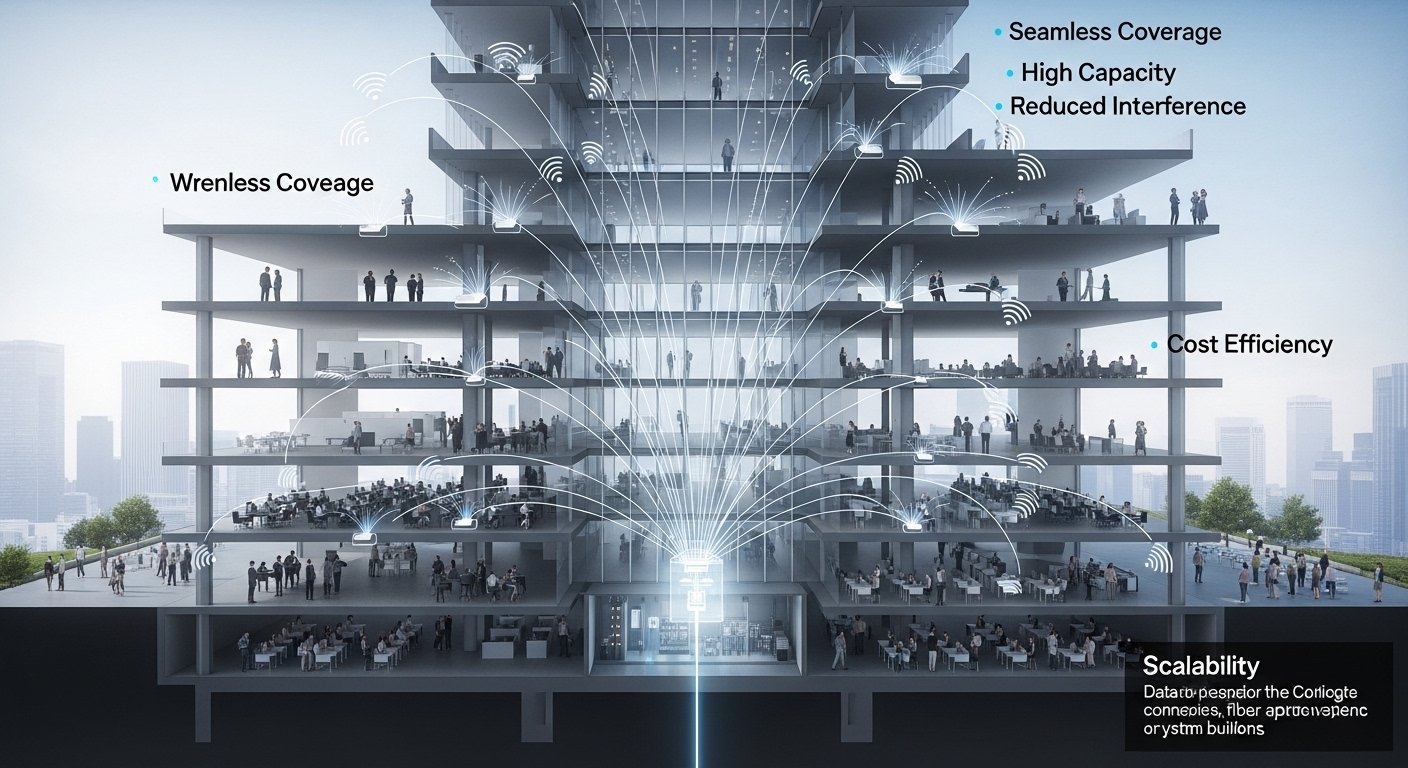
Reliable wireless service isn’t a luxury in large buildings; it’s essential for work, communication, and safety. In properties like office towers, hospitals, and stadiums, poor indoor signals cause dropped calls, slow data, and frustrated tenants. Materials like concrete, steel, and energy-efficient glass often block outdoor signals, creating dead zones in elevators, parking garages, and lower levels. Shared wireless infrastructure is crucial for solving this. A well-designed system ensures stronger indoor coverage and a better user experience. One of the most effective solutions is a neutral host DAS, which allows multiple carriers to deliver service through a single in-building network.
What Shared Wireless Systems Do Inside Large Buildings
Shared wireless systems improve indoor connectivity by distributing a signal throughout a building, bringing coverage closer to the user instead of relying on outside cell towers. A signal is taken from a source and distributed via equipment placed strategically inside the property, reducing dead zones where mobile service would otherwise be weak. Large buildings like crowded offices, busy hospitals, or large convention centers often need this solution to support many simultaneous users and prevent network overload. Shared infrastructure enables building owners to meet high demand without creating separate systems for each provider, offering a more organized and scalable approach to indoor cellular coverage that can support future wireless needs.
How a Neutral Approach Supports Multiple Users
A traditional in-building cellular setup is complicated, as each service provider needs separate equipment, pathways, and maintenance. This approach consumes space, increases costs, and makes the system harder to manage. A neutral host model simplifies this by allowing multiple carriers to use one coordinated system, improving building efficiency and service availability for everyone, regardless of their mobile provider. As a result, many decision-makers see a neutral host DAS as a practical, long-term solution. It supports more users, reduces redundant infrastructure, and streamlines wireless deployment in large buildings. This setup also makes it easier to prepare for future demands like increased data traffic, smart building applications, and the expectation of constant connectivity.
Why Large Buildings Benefit from Better Indoor Coverage
Better indoor wireless performance is more than a convenience; it’s essential. In commercial offices, strong mobile coverage boosts productivity and attracts tenants. For healthcare facilities, reliable wireless service is critical for communication among staff, patients, and visitors. Hotel guests expect seamless connectivity, and in residential towers, a dependable signal impacts resident satisfaction. Public safety is also a key factor, as emergency responders need reliable connectivity in large buildings where signal loss can be a risk. A robust in-building network ensures safer conditions and reliable communication. By investing in these shared systems, property owners enhance the building’s overall value, usability, and resilience.
The Role of Planning and Design
A successful shared wireless solution requires careful planning, site evaluation, and thoughtful design—not just randomly placing equipment. Since every building has unique construction, user density, and performance needs, the process starts with identifying coverage gaps and understanding how people use the space. This ensures the network delivers strong signals where needed and meets capacity goals. Scalability is also crucial, as a flexible design can adapt to evolving demands from new devices, tenants, and data-heavy applications. For this reason, building owners often treat indoor wireless as a long-term investment, choosing solutions that support both current and future requirements.
Conclusion
As mobile performance expectations rise, large buildings need reliable indoor service. A weak signal is more than an annoyance—it affects operations, safety, user satisfaction, and property value. Shared wireless infrastructure offers a practical solution, enabling stronger connectivity without redundant equipment. This approach improves the experience for everyone inside. A neutral host DAS is key to this strategy, broadening indoor coverage, supporting multiple users, and preparing for future demands. With proper planning, it becomes a valuable part of a property’s long-term technology foundation. Modern buildings must provide fast, dependable communication on every level, and shared wireless systems offer an efficient, scalable, and practical way to achieve this.