
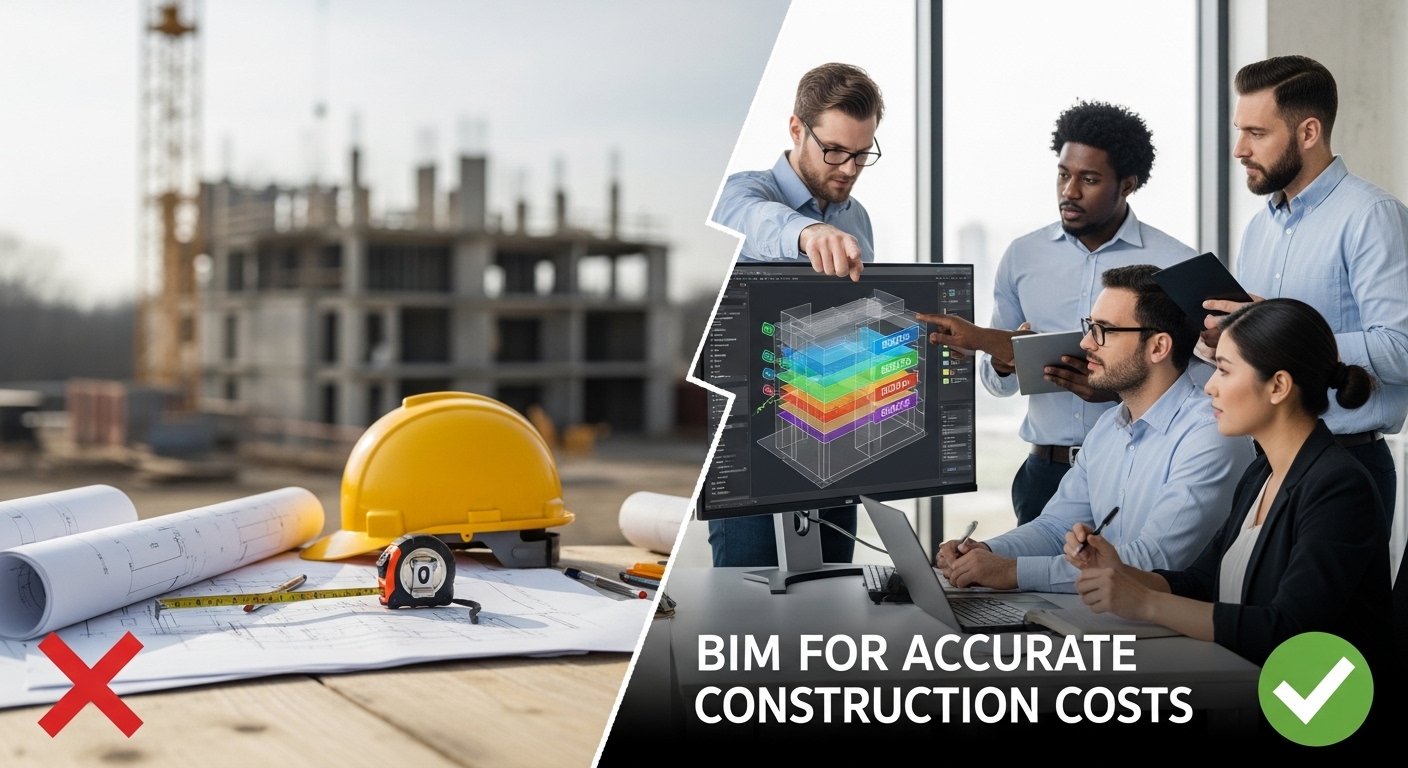
Budgets fail for a simple reason: decisions get made on incomplete information. A design tweak here, a missed finish there — all of it adds up. Project teams then scramble to adjust orders, reschedule crews, and explain overruns to owners who expected better control. That pattern is avoidable. The fix is practical: get accurate quantities early, keep them updated, and let cost planning follow design rather than chase it.
Building information models have shifted estimating away from scaled rulers and toward measurable data. When estimators and modelers work with the same inputs, the numbers actually mean something. That’s the core benefit: less guesswork, fewer surprises.
Measurable design is the foundation of cost accuracy
A drawing tells you the intent. A model gives you countable things. A wall in a model is an area, not a line. A duct is a length, not an assumption. Those are small differences with big consequences.
High-quality BIM Modeling Services produce models that are organized, named consistently, and include the minimal metadata needed for pricing. When the data is exportable in predictable formats, estimators can extract quantities without rebuilding the project from scratch.
Practical model qualities worth insisting on:
- Consistent family names and element IDs
- Material and finish attributes on assemblies
- Trade-layer separation so scopes don’t overlap
- Export-ready formats that preserve units and counts
When the model is a usable dataset, the estimating task shifts from clerical cleanup to meaningful analysis.
Estimators bring judgment to model outputs
Raw counts don’t buy crews. That’s why numbers must be interpreted. Construction estimating services sit at that intersection between model data and real-world execution. Estimators don’t simply multiply area by rate; they add context — crew productivity, site access, sequencing, and waste.
That human layer matters. For example, two walls with identical area values may require very different labor if one sits in a cramped retrofit space and the other in an open new build. Estimators translate model geometry into constructible work packets, and they do it with market knowledge and on-the-ground reality.
When model-derived quantities feed into experienced estimating, the result is a budget that reflects how work will actually happen.
Early estimating prevents late-stage panic
One common mistake is leaving detailed pricing until late in design. By then, decisions are fixed or expensive to reverse. Model-driven workflows allow teams to estimate earlier and more often.
Benefits of early, repeated estimating include:
- Identifying cost drivers while design choices are still low-cost
- Spotting long-lead items that need pre-approval or early procurement
- Comparing alternatives with real numbers instead of guesses
- Aligning owner expectations before contracts are signed
When BIM modeling services and construction estimating services collaborate from the start, the budget becomes a planning tool, not a document to defend.
The value of structured outputs for accountability
Some projects require a higher level of documentation — lenders, public owners, and insurers often demand traceable, line-item detail. That’s where xactimate estimating services or similar structured tools add real value.
Structured estimating provides:
- Recognizable line items and definitions that reviewers understand
- Regional pricing that reflects market realities
- Separation of labor, material, and equipment costs
- Clear audit trails for each figure
When model quantities map into a structured cost framework, stakeholders can see where every dollar came from. That transparency shortens review cycles and lowers friction in approvals.
A practical workflow that keeps costs aligned to design
Consistency beats occasional heroics. Teams that finish on budget use a repeatable rhythm linking model and cost.
A sensible workflow:
- Define naming and metadata requirements at kickoff.
- Have BIM models produce milestone exports.
- Map model elements to a pricing dictionary.
- Have Construction Estimating Services apply local rates and productivity.
- Use Xactimate estimators where formal documentation is needed.
- Reconcile with procurement and field teams before orders.
Run that cycle at each design milestone. Keeping the estimate current with the model avoids the “numbers lag” that wrecks budgets.
Small governance steps that prevent big problems
Many estimating headaches are avoidable. They come from simple lapses — a renamed family, a missing metadata field, or a unit mismatch.
Fast, effective rules:
- Publish a two-page modeling guide and enforce it at kickoff.
- Lock common template families to prevent accidental renames.
- Version-control the mapping spreadsheet so changes are traceable.
- Run sample exports early to catch unit or metadata issues.
These are low-cost habits with high returns. They protect estimator time for analysis rather than cleanup.
Real operational wins you’ll notice quickly
The benefits of model-aligned estimating aren’t abstract. They show up in everyday project life.
Typical early wins:
- Faster bid turnarounds because takeoffs are automated.
- Fewer change orders due to early scope validation.
- Procurement that better matches actual needs.
- Clearer progress tracking with quantities tied to pay items.
Those outcomes protect margins and reduce the stress that comes with last-minute fixes.
People still make the tough calls
Tools produce data. Experience turns data into decisions. BIM models provide the structured facts. Estimators add interpretation and local market insight. Xactimate Estimating Companies add a standardized presentation when required. None of these replaces the project team’s judgment.
A model without an estimator input is just numbers. An estimator without reliable data is guessing. Put both together, and budgets become reliable guides rather than fragile targets.
Closing thought: accuracy as a habit
Accuracy isn’t a one-time milestone; it’s a practice. Make measurable layout and disciplined estimating a part of the challenge’s each day rhythm. Insist on easy model exports, mapping subject, and early estimator involvement. Use dependent reporting where stakeholders need it. Do those matters constantly, and “correct cost” movements from aspiration to recurring.
When teams adopt that habit, initiatives run smoother and proprietors get the outcomes they expect.
FAQs
- How early should estimators get involved with BIM models?
As early as possible — ideally during schematic design, once core geometry and naming standards are set. Early involvement helps shape the model to produce priceable quantities. - Is Xactimate necessary for every project?
No. Use Xactimate Estimating Services when third-party-celebration reviewers or insurers require a standardized, auditable layout. For many personal tasks, a well-mapped model and disciplined estimating offer enough clarity.
3. What’s the simplest step to improve cost accuracy on the next project?
Agree on a concise two-page modeling guide at kickoff, then run a quick export-import test between modelers and estimators to catch unit or naming issues early