
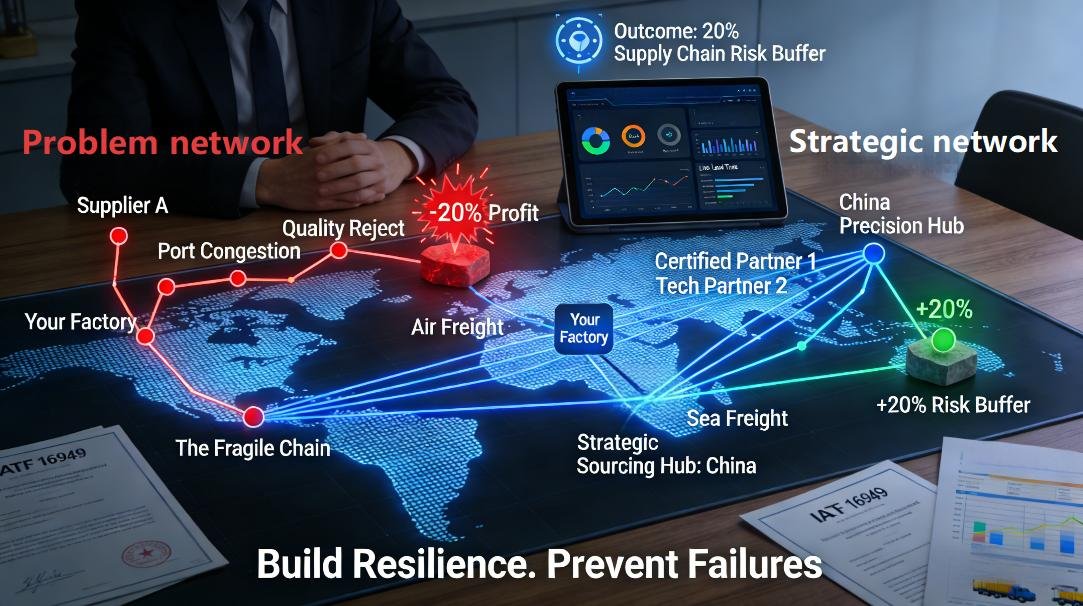
For global brands, sourcing precision CNC parts from China can often feel like a high-stakes gamble. Quotations vary by up to 50%, quality is inconsistent, and delivery delays exceeding 30% are commonplace. This uncertainty translates directly to production line stoppages, product recalls, and damaged brand reputation. Research indicates that up to 20% of supply chain disruptions can be traced back to systematic failures during the supplier selection phase. The core issue lies in procurement decisions that are overly reliant on a single, lagging indicator: “price.” This approach ignores the four foundational dimensions that constitute a supplier’s long-term value: verifiable technical capability, auditable quality systems, transparent cost structures, and robust project management. The traditional “three bids and a buy” model cannot penetrate these critical layers.
This article provides a “Four-Dimensional Supplier Value Assessment Framework” based on data from hundreds of international projects. It guides you on how to move beyond the quote, using quantifiable technical auditing, quality system verification, cost driver analysis, and project management maturity assessment. This transforms supplier selection from a high-risk “price guessing game” into a predictable “value investment,” systematically reducing supply chain risk by over 20%. To apply this framework, we must first redefine what “capability” means, starting with examining the real engineering prowess behind a machine list.
Beyond the Machine List: How to Audit True Technical Capability for Complex Parts?
This section argues that a true assessment of technical capability requires evaluating a supplier’s process knowledge, problem-solving methodology, and engineering agility, not just the brands of machines on their floor.
1. Decoding Process Knowledge: The “How” Behind the Cut
A list of machine brands (DMG MORI, Mazak, etc.) is a starting point, not an end point. True capability lies in the documented process knowledge. For a complex, thin-walled titanium medical housing, ask: “Can you provide a sample process card or cutting parameter sheet detailing the feeds, speeds, toolpaths, and fixturing strategy for this specific feature set?” A supplier with deep expertise doesn’t guess; they have a validated database of parameters for different materials and features. Their ability to interpret and execute advanced geometric dimensioning as per standards like ASME Y14.5 is a litmus test for their ability to speak the language of high-end design and manufacture truly complex components.
2. Evaluating the Problem-Solving Engine
Every new part encounters unforeseen challenges. A supplier’s value is proven in their response. Inquire about their formal problem-solving process. Ask: “Walk us through a recent example where a first-article part failed a critical tolerance. What was your 8D or similar structured analysis, and what corrective actions were implemented in the process?” Listen for evidence of root cause analysis that goes beyond simply re-machining the part, indicating a culture of continuous improvement rather than firefighting.
3. Testing Engineering Agility and Collaboration
Technical capability is also about speed of iteration. In the prototyping phase, assess their engineering feedback loop. After submitting a design change, how quickly can they provide updated CAM simulations, DFM notes, and a revised quote? A fast, insightful turnaround indicates tight integration between their sales, engineering, and programming teams — a hallmark of a true technical partnership rather than a transactional shop. To obtain a comprehensive, systematic methodology for executing this type of in-depth audit, this guide on selecting high-value CNC machining suppliers in China provides an extremely detailed roadmap covering technical, quality, cost, and management dimensions.
Does Your Supplier’s “Quality System” Actually Prevent Defects, or Just Document Them?
This section distinguishes between reactive quality inspection and proactive quality assurance, guiding the reader on how to verify that a supplier’s system is designed to prevent defects at the source.
- The Inspection vs. Assurance Paradigm: Many suppliers have a “quality department” that performs final inspection, sorting good parts from bad. This is a costly, reactive model. The gold standard is proactive quality assurance embedded in the process itself. This is achieved through Statistical Process Control (SPC). During an audit, demand to see real-time SPC control charts for key characteristics on a live production job. Charts that show data points clustered tightly around the nominal value with no trends toward control limits demonstrate a process that is stable, capable, and, most importantly, preventing defects from occurring in the first place.
- Verifying the Measurement System Itself: SPC data is only as reliable as the tools that generate it. A critical, often overlooked audit point is Measurement System Analysis (MSA). Ask for the most recent Gage R&R (Repeatability & Reproducibility) reports for their critical CMMs and other measuring equipment. A result below 10% is excellent, proving that measurement variation is minimal and the inspection data can be trusted. This level of metrological rigor is what separates serious manufacturers from the rest.
- The Systemic Backbone: Certified Processes: This preventive approach is not optional in regulated industries; it is systematized. Suppliers adhering to standards like IATF 16949 (automotive) or ISO 13485 (medical) are required to implement control plans and production part approval processes (PPAP). These are not mere certificates on the wall but structured, living documents that mandate preventive controls, risk analysis (via FMEA), and rigorous validation before production begins. This systematic approach is the most reliable way to de-risk your CNC machining supplier selection.
The True “Cost” of a Cheaper Quote: A Transparent Breakdown for Informed Decisions.
This section provides a model for deconstructing a quotation to understand true cost drivers, arguing that transparency is the foundation for trust and that the lowest unit price often masks a higher Total Cost of Ownership (TCO).
1. Anatomy of a Transparent Quote
A professional quote is a financial model of the part. It should provide a clear, itemized cost breakdown:
- Material Cost: Specifying the exact alloy, raw stock size, and the calculated material utilization percentage.
- Programming & Setup (NRE): The one-time engineering cost.
- Machining Time: Detailed by operation (milling, turning, drilling) with associated machine-hour rates.
- Secondary Operations & Inspection: Costs for heat treatment, plating, and quality control (e.g., First Article Inspection).
A quote that provides only a lump sum obscures where your money is going and makes intelligent cost analysis impossible.
2. The TCO Lens: Seeing Beyond the Unit Price
Consider two quotes for the same aerospace bracket. Supplier A is 20% cheaper. Supplier B’s quote is higher but shows 30% less machine time due to a more efficient 5-axis strategy and includes a comprehensive FAIR. The “cheaper” part from Supplier A may have hidden costs: longer lead time due to inefficient routing, higher internal QC effort, and a greater risk of a late-stage failure causing a production line stoppage. The real metric is Total Cost of Ownership, which includes unit price, quality failure costs, management overhead, and risk.
3. Building Trust Through Financial Transparency
A supplier willing to provide this level of detail is demonstrating process control and commercial integrity. They understand their costs and are confident in their efficiency. This transparency enables collaborative value engineering. Therefore, seamlessly integrating transparent cost analysis with high-quality, stable delivery is achievable by leveraging a modern online custom CNC machining services platform, which integrates quoting, engineering collaboration, and production tracking into a single, accountable workflow.
From Prototype to 10,000 Parts: Can Your Supplier Scale Without Stumbling?
This section examines a supplier’s “process resilience” and supply chain maturity, critical for successfully scaling from a validated prototype to reliable volume production.
1. The Critical Handoff: From Prototype to Production Control
A perfect prototype is meaningless if the process to make it cannot be replicated. The key is process documentation and transfer. The optimized parameters, tooling, and fixturing from the prototype phase must be locked into a formal production control plan. During evaluation, ask: “How do you capture and institutionalize the learnings from the prototype run to ensure the production batch is identical?” Look for evidence of structured handoffs between their NPI (New Product Introduction) and production teams.
2. Supply Chain Depth and Stability
A supplier’s reliability is only as strong as their own supply chain. For CNC parts manufacturing in China, this is paramount. Probe their supplier management practices: “How do you qualify and audit your sub-suppliers for raw materials, heat treatment, or coating?” Do they have certified sources and contingency plans for material shortages? A robust supplier manages its upstream supply chain as diligently as its own shop floor, a principle embedded in advanced supply chain management frameworks like the APICS SCOR model.
3. Capacity Planning and Contingency Management
Finally, assess their operational maturity. Ask about their capacity planning process and historical on-time delivery (OTD) rate. Inquire how they handle demand surges or machine downtime. Do they have cross-trained personnel and flexible capacity? Answers to these questions reveal their ability to be a predictable, long-term partner for your industrial procurement needs, capable of growing with your business.
The 5-Point Supplier Audit: Questions That Separate Partners from Vendors.
This final section provides a practical audit checklist of probing questions designed to uncover a supplier’s strategic thinking, systemic approach, and long-term partnership potential.
1. Testing for Value-Add and Proactive Engineering
Move beyond “Can you make this?” to “How would you make this better?” A powerful question is: “Can you provide an example where your team identified a potential design flaw or cost-saving opportunity during the quoting phase and how that feedback was received?” A true partner acts as an extension of your engineering team. A vendor only quotes the print.
2. Probing Commercial Resilience and Risk Management
Test their business acumen and stability with: “How do you manage cost volatility for key raw materials (e.g., aluminum, stainless steel), and what is your communication protocol to clients if a surcharge is necessary?” A transparent, structured response indicates a mature business. Also, ask about their order change process to understand their flexibility and discipline.
3. Assessing Systemic Integrity and Long-Term Vision
Finally, evaluate their overarching philosophy: “What is your process for ensuring quality consistency with outsourced special processes like anodizing or plasma coating?” This tests their holistic quality assurance system. Furthermore, asking about their investment in technology and training reveals whether they are a static workshop or a growing partner invested in the future. The answers to these questions will clearly separate transactional vendors from strategic manufacturing solutions providers in your global sourcing guide.
Conclusion
In the global precision manufacturing supply chain, the most valuable competitive advantage does not come from the lowest unit price, but from the deep ability to identify and manage the comprehensive value of a supplier. By adopting a Four-Dimensional Assessment Framework based on Technology, Quality, Cost, and Management, companies can transform the procurement function from a passive cost center into an active engine for value creation and risk management. This builds a resilient, efficient, and trustworthy global supply network.
FAQs
Q: What is a realistic price range difference when comparing quotes from 3-5 different CNC machining suppliers in China?
A: A price variance of 30-60% for the same part is common and signals a need for deep analysis. Differences often stem from material grade assumptions, machine time estimates, and overhead allocation. A transparent quote breakdown is crucial. Extremely low quotes may indicate risks in quality, materials, or sustainability.
Q: How can I verify a supplier’s quality claims remotely before placing a large order?
A: Request a First Article Inspection (FAIR) Report for a recent, similar project, including full CMM data and material certs. You can also order a small pre-production batch (50-100 pcs) to audit their process consistency, delivery, and communication. Reputable suppliers welcome this due diligence.
Q: What are the biggest hidden costs when sourcing CNC parts from China?
A: Major hidden costs include: poor quality leading to rework/scrap, significant internal project management overhead, unexpected logistics/customs delays, and costs from design changes due to lack of early DFM input. A supplier with robust systems often results in a lower Total Cost of Ownership.
Q: Is it better to work with a large, full-service factory or a smaller, specialized workshop in China?
A: It depends. Large factories offer scalability, in-house services, and strong systems, ideal for high-volume or regulated industries. Specialized workshops can be more agile and cost-effective for complex, low-volume parts. The key is matching their core competency to your project’s primary challenges.
Q: How do international logistics and tariffs impact the final cost and lead time?
A: Logistics can add 10-25% to the part cost and 1-4 weeks to the timeline. Always request DDP (Delivered Duty Paid) quotes for a predictable total landed cost. A reliable supplier will have established freight forwarder partnerships to optimize this process.