
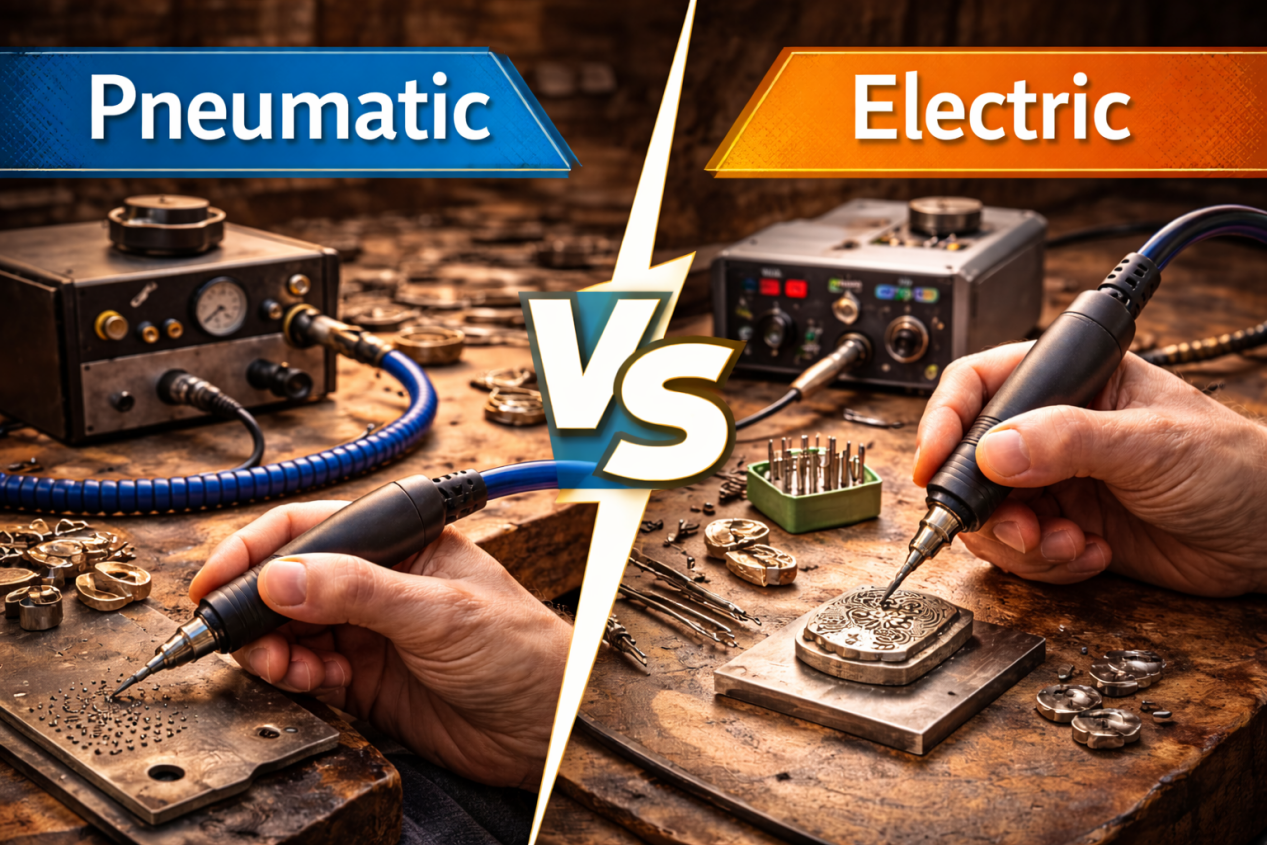
At some point in every engraver’s journey, a decision has to be made. The entry-level tools that once felt sufficient begin to show their limits. Lines require more effort. Long sessions bring fatigue. And the question naturally arises: is there a better system?
Most modern engravers eventually compare two primary options—electric engraving tools and pneumatic engraving systems. On the surface, they may appear similar. Both reduce manual effort and increase cutting efficiency. But in practice, they offer very different experiences.
Understanding those differences is essential for anyone serious about craftsmanship.
The Appeal of Electric Engraving Tools
Electric engraving tools are often the first upgrade from manual gravers. They are accessible, relatively affordable, and easy to set up. Many operate like rotary tools or micro motors, spinning at high speed to remove material.
For light decorative work or simple marking, electric systems can perform adequately. They are convenient and portable, which makes them attractive to hobbyists and occasional users.
However, as projects become more complex, the limitations of electric tools become clearer. High-speed rotation removes material differently than impact-based engraving. Control over depth can feel less precise, and achieving clean, traditional engraving lines may require additional finishing work.
Electric systems often trade impact precision for speed.
How Pneumatic Engraving Works Differently
Pneumatic engraving operates on a fundamentally different principle. Instead of spinning, it uses compressed air to create controlled, rapid impacts that drive the graver forward. The motion closely resembles traditional hand engraving, but with consistent mechanical assistance.
This impact-based action allows for more controlled cuts, especially when working on harder metals. Depth remains stable across long lines. Shading and ornamental detailing feel more natural because the motion mirrors classic engraving techniques.
For serious engravers, this similarity to traditional cutting methods is significant. Pneumatic tools enhance craftsmanship rather than altering it.
Control and Line Quality
One of the most noticeable differences between electric and pneumatic systems lies in line quality.
Electric rotary tools remove material through abrasion. This can create smooth channels, but they often lack the crisp edges associated with traditional engraving. Achieving that sharp definition may require extra polishing or corrective work.
Pneumatic engraving, by contrast, cuts metal with impact. The result is cleaner, more defined lines that maintain character even in detailed work. For jewelry engraving, scrollwork, or fine lettering, this precision becomes essential.
Consistency also improves. Because pneumatic systems deliver steady impact regardless of hand fatigue, line depth remains uniform throughout extended sessions.
Fatigue and Ergonomics
Long-term use reveals another major difference between these systems.
Electric tools, especially rotary types, can generate vibration that travels into the hand. Over time, this may contribute to discomfort during prolonged sessions. Additionally, maintaining consistent pressure while controlling rotation can still require noticeable effort.
Pneumatic systems reduce this strain significantly. The tool delivers force independently of hand pressure, allowing the engraver to focus on guidance rather than pushing. This dramatically lowers fatigue during long projects.
For professionals who engrave daily, the ergonomic advantage alone often justifies the transition.
Noise and Workspace Environment
Workspace environment also matters. Electric rotary tools can produce high-pitched noise, particularly at elevated speeds. Pneumatic systems generate sound as well, but the tone and intensity are typically different, often perceived as more stable and less sharp.
Modern pneumatic systems, especially compact models like those found in Katway’s pneumatic engraver range, are designed to operate efficiently within small studios. Their integrated designs reduce clutter and maintain a clean bench setup.
This matters for independent makers who prioritize both comfort and organization.
Versatility in Professional Applications
Electric engraving tools can be useful for certain applications such as surface texturing, light marking, or decorative effects. However, when precision becomes the primary goal, pneumatic systems often outperform.
Hard metals, deep cuts, intricate shading, and traditional ornamental engraving all benefit from impact-based cutting. The control offered by pneumatic tools supports a broader range of advanced techniques.
For engravers who plan to expand their skills, investing in a system that supports growth is critical.
Learning Curve Considerations
Electric tools are often considered easier for beginners because they resemble familiar rotary devices. However, this simplicity can be misleading. Developing clean engraving technique still requires control and understanding of depth.
Pneumatic systems may require initial adjustment, but once mastered, they provide a more stable foundation for advanced work. Because the motion mirrors traditional engraving, skills transfer more naturally to professional-level craftsmanship.
For learners who aim to progress beyond basic marking, pneumatic systems offer a stronger long-term platform.
Long-Term Investment Perspective
Choosing between electric and pneumatic engraving is not only about immediate needs. It is about long-term direction.
If engraving is an occasional hobby, electric systems may be sufficient. But if engraving is a profession—or intended to become one—the benefits of pneumatic tools compound over time. Reduced fatigue, improved precision, and higher consistency directly impact career longevity.
Investing once in the right system often prevents repeated upgrades later.
Tradition and Innovation Working Together
Some engravers hesitate to adopt pneumatic tools out of respect for tradition. But innovation does not erase tradition—it refines it.
Pneumatic engraving preserves the feel of classic cutting while removing unnecessary physical strain. It supports craftsmanship rather than replacing it. This balance between tradition and modern efficiency is why pneumatic systems have become the preferred choice in many professional workshops.
Final Thoughts: Choosing the System That Matches Your Ambition
Both electric and pneumatic engraving systems have their place. The key question is not which tool is newer or more powerful. It is which tool aligns with your goals.
If your ambition is to produce occasional decorative work, electric tools may serve you well. If your goal is precision, long-term sustainability, and professional growth, pneumatic engraving provides a clear advantage.
Understanding this distinction allows makers to invest wisely and build a workshop that supports not only current projects, but future potential.